What if we could make daily reflection as easy as taking a photo?
There's no convenient way to build a consistent reflection habit. Most journaling apps ask too much, and most people give up within a week. This gap between wanting to reflect and actually sticking with it was the starting point for Bloom.
There is no low-effort way to build a consistent reflection habit.
Conversations with people who had tried and dropped journaling apps led to two recurring pain points:
Blank pages and open-ended prompts create friction. Most people stall before they start writing.
Without streaks, recaps, or visible progress, the habit doesn't stick past the first week.
- Feels slow and laborious
- Inconsistent habit formation
- Feels like homework at the end of the day
- Quick and effortless
- Genuinely meaningful
- A natural part of daily life
Instead of improving journaling, I reframed the experience entirely.
How might we make reflection feel like a natural part of someone's day?
This project started with a story
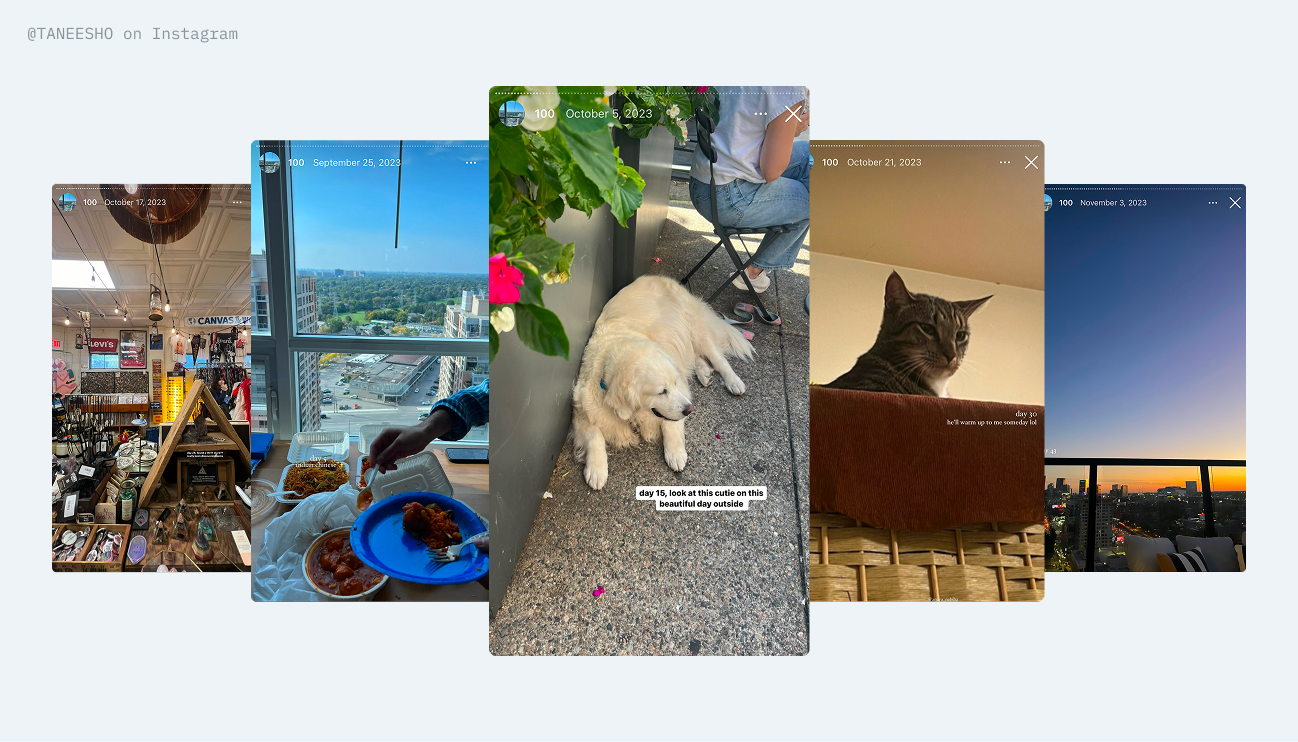
I came across someone doing 100 Days of Gratitude: one story every day about something small they appreciated. Nothing aesthetic or complicated, just consistency.
What stuck with me wasn't the content itself, but the habit behind it. That consistency felt rare, especially for something like reflection.
I tried learning Spanish (emphasis on tried) and it taught me more about journaling than I expected.
Around the Summer of '25, I picked up Duolingo. I wasn't great at Spanish, but I kept coming back. Streaks, reminders, progress feedback. The experience made returning feel natural.
That's when something clicked. Reflection apps don't fail because people don't care about reflecting. They fail because they don't give people a reason to come back tomorrow.
The most successful daily-habit apps don't succeed because of their content. They succeed because returning is designed into the experience. Streaks, recaps, low-effort entry points. Journaling apps have none of this.
A photo album, not a productivity tool.
Before designing visuals, I explored structure. Where do memories live? How do users revisit them? How visible should progress feel? How fast can an entry be created?
The goal wasn't feature richness. It was friction removal.
Most journaling apps feel like productivity tools. Bloom needed to feel closer to a photo album: memory cards, soft gradients, calm typography, and visual browsing over text-heavy layouts.
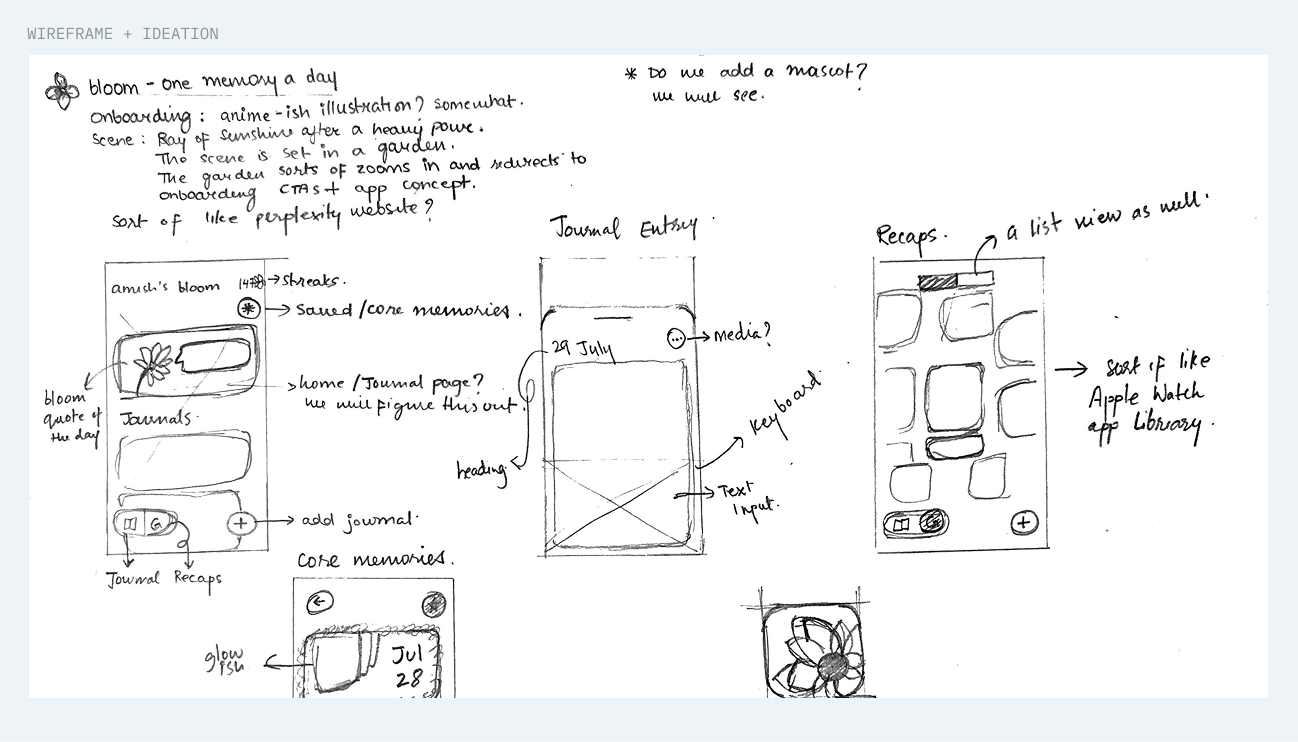
Memory capture starts with an image, followed by a short caption. Writing is effort; photos are easy. This keeps the barrier to entry as low as possible.
Consistency needs rewards. Recaps let users see patterns across their memories instead of isolated entries, acting as emotional checkpoints rather than summaries.
Some moments matter more than others. Inspired by Inside Out, Core Memories let users highlight entries they don't want buried in the timeline, creating layers of reflection instead of a flat archive.
Reflection can feel solitary. A sunflower mascot quietly supports the experience without turning it into a gamified system. It doesn't reward behavior loudly. It just stays present.
One photo. One line. One memory saved.
Bloom isn't designed for writing pages. It's designed for capturing moments: a photo and a short caption. That's one memory.
Reducing effort makes consistency possible. And consistency is what makes reflection meaningful over time.
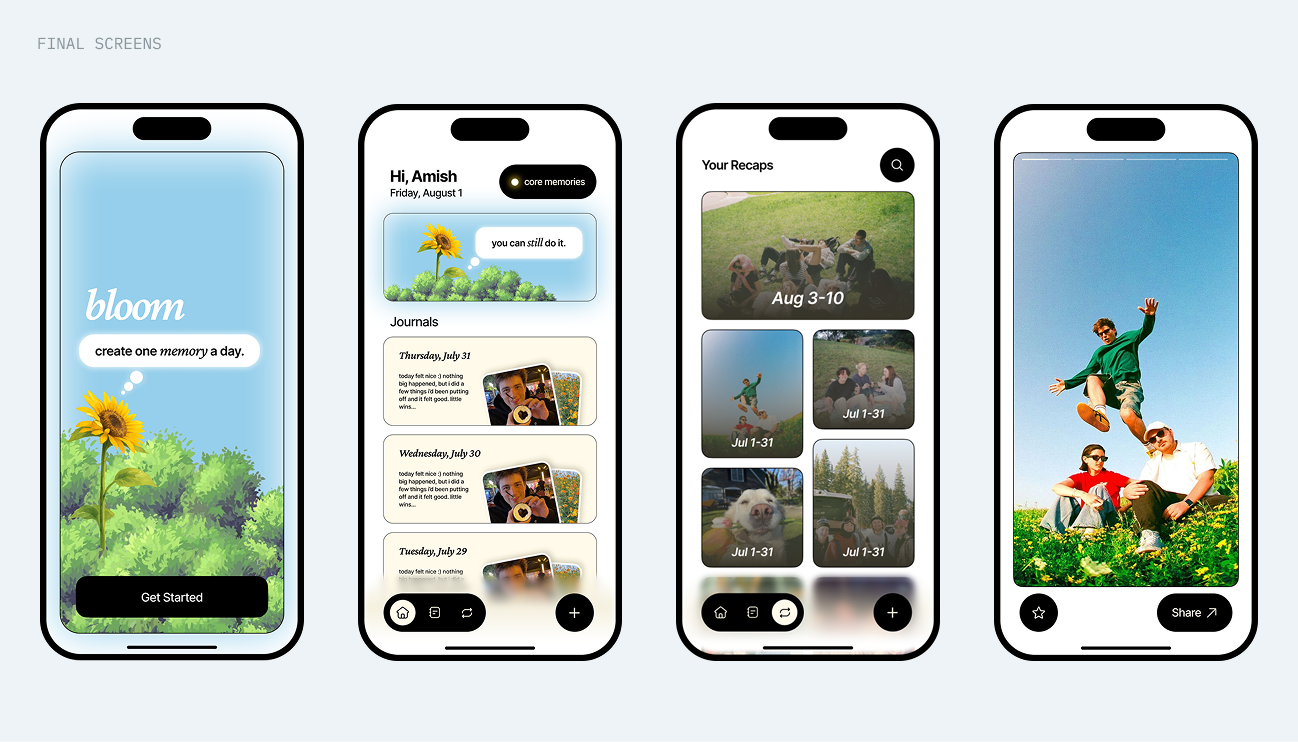
Add a memory with one photo and one line in under 10 seconds.
See your weeks and months at a glance through weekly and monthly recaps.
Pin the moments that matter as Core Memories, entries you never want buried in the timeline.
What I learned
People don't avoid reflection because they don't value it. They avoid it because the experience asks too much at the wrong time of day.
By reducing the experience to one memory per day, Bloom turns reflection from something intentional into something natural.